

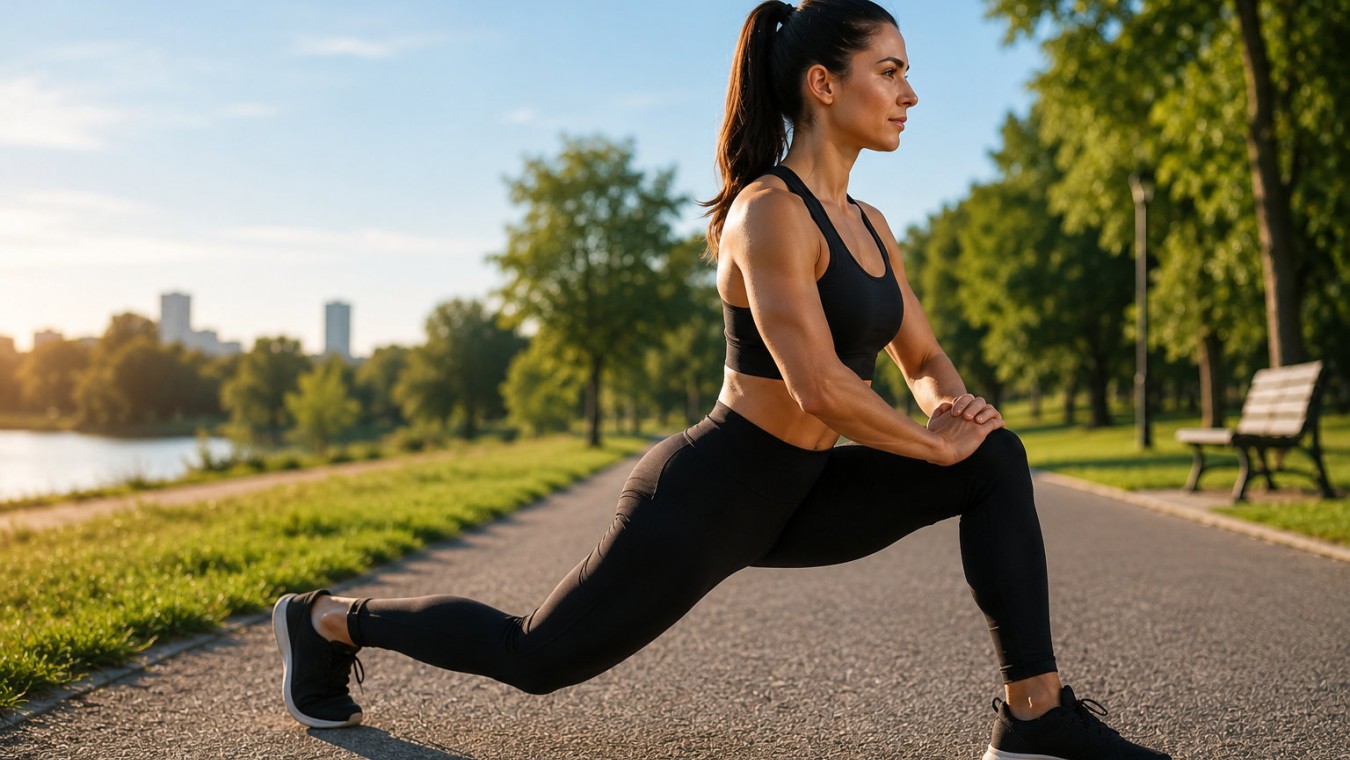
The short answer: outdoor workouts without equipment can be fully effective - as long as they're not just a random mix of squats, push-ups and burpees. To get results, you need a clear goal: strength, fitness, endurance, mobility or weight control. The best approach for most people is a combination of bodyweight exercises, walking or interval running, core and mobility work, plus smart intensity management on hot days.
Summer often disrupts your routine. Some people travel, others lose access to a gym, and some simply want to get outside. The problem is that many outdoor workouts turn into chaotic "exhaust yourself as much as possible" sessions. That's not a good strategy. You can sweat a lot and still not stimulate your muscles enough. You can do a heavy HIIT session and then feel wrecked for two days - for no good reason.
In this article you'll get 5 concrete ideas for outdoor workouts without gym equipment, with options for beginners and more advanced trainees. You'll see how to warm up, how to choose the right intensity, when to be careful in the heat, and which supplements make sense if you're training outdoors in summer.
Who are outdoor workouts without equipment suitable for?
Outdoor workouts are a good choice if you want to maintain fitness, improve your conditioning, burn more energy throughout the day, or keep a training rhythm when you can't get to a gym. They're especially convenient in summer, while travelling, or during periods when your time is limited.
But there's an important detail: training without equipment isn't automatically easy. With the right structure, it can be seriously demanding. Push-ups, squats, lunges, sprints, stair climbing and isometric holds can all build strength, endurance and body control. The limitation is different: it's hard to progress indefinitely using only your bodyweight, especially if your goal is maximum muscle mass.
| Goal | Is outdoor training suitable? | What to expect realistically |
|---|---|---|
| Weight loss | Yes, if combined with dietary control | Higher energy expenditure, better conditioning, easier adherence to routine |
| Maintaining fitness | Yes | An excellent option for summer, holidays or a busy daily schedule |
| Muscle mass | Yes, but with limitations | Good stimulus for beginners and intermediates, but harder to progress without weights |
| Conditioning | Yes | Intervals, hills and circuit training work very well |
| Recovery and mobility | Yes | Low-intensity outdoor sessions are often more enjoyable and sustainable |
Myth vs reality: does a workout have to "break" you to work?
Myth: if an outdoor workout doesn't leave you gasping for air, it wasn't effective.
Reality: an effective workout isn't measured only by sweat, heart rate or muscle soreness. It's measured by whether it provides the right stimulus and whether you can repeat it frequently enough. The World Health Organization recommends that adults engage in regular physical activity, including aerobic activity and muscle-strengthening exercises throughout the week. That doesn't mean every session has to be maximally hard.
The American College of Sports Medicine also emphasises consistency and training of major muscle groups, noting that for many people, no complex programme is needed to see benefit. Bodyweight exercises, resistance bands, and home or outdoor workouts can all be sufficiently effective when performed consistently and at an appropriate difficulty level.
A good outdoor workout isn't the one that punishes you. A good workout is one you can perform with quality, recover from, and repeat in 2-3 days.
Before you start: a 7-minute warm-up for outdoor training
Outdoors, the warm-up is often skipped because the session seems "easier". That's a mistake. If you're going to do jumps, sprints, lunges, push-ups or core work, your joints and nervous system need to be prepared.
A short warm-up without equipment
- 2 minutes of easy walking or slow jogging - the goal is to raise your body temperature, not to tire yourself out.
- 10 arm circles forward and backward - prepares the shoulder girdle for push-ups and planks.
- 10 squats at a controlled pace - no rushing and no bouncing.
- 8 reverse lunges per leg - easier on the knees than forward lunges for many people.
- 10 glute bridges from the floor - activates the glutes and posterior chain.
- 20-30 second plank - engages the core without unnecessary strain on the lower back.
- 2 accelerations of 10-15 seconds - only if you're going to do intervals, stairs or sprints.
If training on a hot day, extend the warm-up but reduce the intensity. The goal is to ease gradually into the workout, not to start at maximum heart rate in the first 3 minutes.
How to choose the right intensity?
The most practical method without a watch or heart rate monitor is the RPE scale - a subjective rating of perceived exertion from 1 to 10. At 1 you barely feel any effort. At 10 you're at maximum and can't continue.
| RPE | How it feels | When it's appropriate |
|---|---|---|
| 3-4 | Light effort, you can talk comfortably | Recovery, mobility, easy walk |
| 5-6 | Moderate effort, you speak in short sentences | Base conditioning, beginners, hot days |
| 7-8 | Hard but controlled | Circuit training, intervals, more advanced trainees |
| 9-10 | Near maximum or maximum | Only for short intervals and only if you're adapted |
For most people, 70-80% of outdoor workouts should reasonably stay in the RPE 5-7 zone. If every session is RPE 9-10, you risk accumulating fatigue, compromising technique, and starting to skip workouts.
Idea 1: Full-body circuit training
This is the most practical option if you want one workout that targets legs, chest, back, shoulders, core and conditioning. It suits a park, garden, playground or beach - as long as the surface is stable.
How to do it
Perform the exercises one after another. Rest 60-90 seconds after the full circuit. Complete 3-5 rounds depending on your level.
| Exercise | Beginners | Advanced | Main focus |
|---|---|---|---|
| Bodyweight squat | 10-12 reps | 20 reps or squat with pause at the bottom | Legs, glutes |
| Push-ups | On a bench or from knees | Standard or with slow lowering | Chest, shoulders, triceps |
| Reverse lunges | 8 per leg | 12-15 per leg | Legs, balance |
| Plank | 20-30 seconds | 45-60 seconds | Core, stability |
| Mountain climbers | 20 seconds | 40 seconds | Core, heart rate, conditioning |
When it makes sense
This workout makes sense when you want a quick, balanced session without complicated organisation. It's good for days when you don't want to think much but still want to train well.
When it's not the best choice
It's not the best choice if you have pain in your wrists, shoulders or knees and the standard exercise form bothers you. In that case, reduce the volume, use easier variations, or choose a mobility and walking session instead.
Idea 2: Interval walking and bodyweight exercises
This is an excellent option for beginners, people who are overweight, those returning after a break, or training on a warmer day. Don't underestimate walking. When it's structured, it can be an outstanding conditioning workout with low risk.
Sample 30-minute session
- 5 minutes easy walking.
- 2 minutes brisk walking.
- 10 squats.
- 1 minute easy walking.
- 2 minutes brisk walking.
- 8 reverse lunges per leg.
- 1 minute easy walking.
- 2 minutes brisk walking.
- 20-30 second plank.
- Repeat the cycle 2-3 times.
If you can't speak in short sentences during the brisk walking, the pace is probably too high. This isn't a competition. The goal is to accumulate movement without destroying your recovery.
Why it works
This approach combines aerobic loading with short strength stimuli. For people who don't train regularly, this is often more sustainable than a heavy HIIT workout. It can also be done almost anywhere and doesn't require a perfect surface.
Idea 3: Stairs or hills for conditioning and legs
Stairs and hills are a natural "piece of equipment" for training. They increase the load on your legs and cardiovascular system without needing to carry weights. But technique and dose matter here.
Beginner version
- Warm up for 7-10 minutes.
- Climb the stairs or hill for 20-30 seconds at a moderate pace.
- Walk back down slowly.
- Repeat 6-8 times.
- Finish with 5 minutes of easy walking.
Advanced version
- 10-minute warm-up.
- 30 seconds fast climbing.
- 90 seconds recovery.
- 8-12 sets.
- Followed by 2 rounds: 15 squats, 10 push-ups, 30-second plank.
Don't sprint down the stairs. This carries unnecessary risk for ankles, knees and Achilles tendons. The climb is the working part. Coming down is recovery.
When to avoid this workout
Avoid it if you have knee, Achilles, or lower back pain, or in very high temperatures. If you've slept poorly, haven't eaten enough, or feel dizzy, choose a lighter session.
Idea 4: Mobility, core and stability
Not every workout has to be hard. A mobility and stability session can be exactly what you need between two more intense workouts. It keeps joints moving, improves body control, and can reduce the feeling of stiffness.
Mobility isn't just "stretching after a workout". It's the active ability to control your positions.
20-minute session
| Exercise | Time/reps | Focus |
|---|---|---|
| Cat-cow | 8-10 reps | Spine, breathing |
| 90/90 hip rotations | 8 per side | Hip joints |
| Deep squat hold | 30-45 seconds | Ankles, hips, squat position |
| Dead bug | 8-10 per side | Core, lower back control |
| Side plank | 20-30 seconds per side | Lateral stability |
| Bird dog | 8-10 per side | Back, glutes, control |
This workout suits mornings, rest days or after travel. It shouldn't exhaust you. If you do it correctly, you should feel more mobile, not more drained.
Idea 5: Short HIIT session without equipment
HIIT workouts are popular because they're short and intense. Systematic review data support the effect of high-intensity intervals on cardiorespiratory fitness in adults - but that doesn't mean HIIT is the right choice every day or for every person.
If you're a beginner, have high blood pressure, cardiovascular problems, significant anxiety, poor sleep or joint issues, start with a more moderate option. When in doubt, consult a specialist.
15-minute version
After warming up, do 6-8 rounds:
- 30 seconds work
- 60 seconds rest
Alternate between the following exercises:
- Fast squats without jumping.
- Mountain climbers.
- Push-ups on a bench or the floor.
- Brisk walking or light jogging in place.
Harder version
If you're adapted and have no contraindications, you can use 20 seconds work and 40 seconds rest for 10-12 rounds. Don't start with burpees if your technique breaks down after the first minute. Burpees aren't required for the workout to be effective.
4-week outdoor workout plan
A single workout is useful. But results come from consistency. Here is a sample plan for someone who wants to train 3 times a week outdoors, without equipment.
| Week | Workout 1 | Workout 2 | Workout 3 | Main goal |
|---|---|---|---|---|
| 1 | Circuit training - 3 rounds | Interval walking - 25 min | Mobility and core - 20 min | Adaptation |
| 2 | Circuit training - 4 rounds | Stairs/hill - 6 sets | Interval walking - 30 min | More volume |
| 3 | Circuit training - 4-5 rounds | HIIT - 6-8 rounds | Mobility and core - 25 min | Intensity |
| 4 | Circuit training - 3 rounds with better technique | Stairs/hill - 6 sets moderate | Long walk + mobility | Deload and assessment |
After 4 weeks you don't need to change everything. Better to change just one parameter: one more round, slightly shorter rest, slower lowering on push-ups, or longer brisk walking. Small progression - but measurable.
How to measure progress without equipment?
During outdoor workouts many people gauge only whether they sweated. That's a weak indicator, especially in July and August. Sweating depends on temperature, humidity, clothing, heat adaptation and individual differences.
Better indicators are:
- Number of quality reps - for example, going from 8 to 12 push-ups with good technique.
- Total working time - for example, 25 minutes of movement instead of 18.
- Breathing control - you recover faster between sets.
- Perceived difficulty - the same workout feels easier after 2-3 weeks.
- Measurements and weight - if the goal is fat loss, track trends, not daily fluctuations.
- Sleep and appetite - if these deteriorate sharply, the intensity may be too high.
If your goal is fat reduction, combine your training with the basics of strength and cardio workouts for weight loss. The training itself helps, but nutrition remains the decisive factor.
Training in hot weather: when to slow down?
Summer outdoor workouts carry one specific risk: heat stress. High temperature and humidity make it harder for the body to cool down. Dehydration can worsen perceived effort, reduce work capacity and increase the risk of heat exhaustion.
Practical rules:
- Train early morning or evening whenever possible.
- Avoid maximum intervals during the hottest hours.
- Choose shade, a park or a route with access to water.
- Wear light clothing and avoid neoprene belts or "sauna" garments.
- Reduce intensity if you feel dizziness, chills, unusual weakness, nausea or confusion.
The CDC recommends that people pay attention to cooling, hydration and symptoms of heat illness in hot weather. The Mayo Clinic also notes that when training in the heat it's important to watch for signs such as extreme fatigue, dizziness, muscle cramps, weakness and symptoms of heat exhaustion.
Hydration and electrolytes: when is water enough and when isn't it?
For a short, moderate workout, water is often perfectly sufficient. However, if you're training for a long time, sweating heavily, doing intervals in the heat, or on a low-carb diet, electrolytes can make more sense. The main electrolytes lost through sweat include sodium, chloride and in smaller amounts potassium, magnesium and other minerals.
There's a nuance here. Electrolytes don't make the workout magically more effective. They're a practical tool for maintaining fluid and mineral balance, especially during prolonged sweating. If you've trained lightly for 20 minutes in cool weather, you probably don't need a special drink. If you've done 60-90 minutes of activity in the heat and your shirt is completely soaked, the situation is different.
| Situation | Most logical choice | Note |
|---|---|---|
| 20-30 minutes light workout | Water | Electrolytes usually not needed |
| 45-60 minutes moderate workout in the heat | Water + possibly electrolytes | Especially with heavy sweating |
| Long activity over 60-90 minutes | Water, electrolytes and carbohydrates as needed | Depends on intensity and temperature |
| Workout with cramps, dizziness or unusual weakness | Stop the session and cool down | Don't try to solve the problem with a supplement alone |
Which supplements make sense for outdoor workouts?
Supplements are not required for outdoor training. But some categories can be helpful if they solve a specific problem. The important thing is not to buy a product for the wrong reason.
| Category | When it makes sense | When it's not worth it | Realistic effect |
|---|---|---|---|
| Electrolytes | With heavy sweating, long activity, hot weather | Short and light workout in cool weather | Easier maintenance of hydration and mineral balance |
| Protein | If you struggle to meet daily protein needs from food | If you get enough protein from your diet | Supports recovery and preservation of muscle mass |
| EAA or BCAA | If you train fasted or have long gaps between meals | If protein intake is adequate and meals are well distributed | Practical convenience, not a substitute for whole food |
| Stimulant-free pre-workouts | If you want pump, focus or better feel without caffeine | If you expect them to compensate for poor sleep or nutrition | May support the training experience, but don't replace the basics |
| Creatine | If your goal is strength, reps and training volume | If you expect direct fat burning | Supports strength work and short intense efforts |
If you're training outdoors for weight loss, don't start with a fat burner. Start with movement, nutrition, sleep and adequate protein.
Common mistakes in outdoor workouts
1. Only cardio, no strength stimulus
Walks and running are beneficial, but if your goal is better physique, strength and muscle preservation, add bodyweight exercises. Even 2-3 short strength blocks per week can make a difference.
2. Too much jumping
Jumps look "athletic" but aren't required. If you're overweight, have knee pain or are training on a hard surface, reduce plyometrics. Choose squats, reverse lunges, incline walking and controlled exercises.
3. Burpees in every workout
A burpee is an exercise, not a religion. It can be useful, but it's often performed with poor technique and places unnecessary load on wrists, lower back and shoulders. If technique breaks down, replace it with mountain climbers, squats or brisk walking.
4. Training in the hottest part of the day
This doesn't demonstrate discipline. Sometimes it's simply poor judgement. If temperatures are high, choose morning, evening, shade or a lighter session.
5. No progression
If you do the same thing every week, the body adapts. Progression can mean more reps, more rounds, a more controlled tempo, shorter rest, or a harder exercise variation.
6. Overdoing intensity when sleep-deprived
When you're sleep-deprived, the body doesn't respond as well to high intensity. On those days, choose walking, mobility or a moderate circuit workout.
How to adapt the workout to your level?
| Exercise | Easier variation | Standard variation | Harder variation |
|---|---|---|---|
| Push-ups | On a bench | On the floor | With 3-second slow lowering |
| Squat | Box squat to a bench | Full bodyweight squat | Squat with pause at the bottom |
| Lunge | Reverse lunge with small range of motion | Reverse lunge | Bulgarian split squat on a bench |
| Plank | From knees | Standard plank | Plank with leg raise |
| Intervals | Brisk walking | Light jogging | Hill or stairs |
The rule is simple: choose a variation where the last reps are hard but technique remains stable. If your lower back sags, knees collapse inward or breathing goes completely out of control, the variation is probably too hard.
Sample 35-minute outdoor workout
This is a balanced session you can use as your main workout 1-2 times a week.
Structure
- Warm-up - 7 minutes: walking, squats, arm circles, reverse lunges, plank.
- Main circuit - 18 minutes: 4 exercises, 3-4 rounds.
- Conditioning finisher - 5 minutes: brisk walking or short intervals.
- Cool-down - 5 minutes: easy walking and light mobility.
Main circuit
- 12-15 squats
- 8-12 push-ups
- 10 reverse lunges per leg
- 30-45 second plank
Rest 60-90 seconds between rounds. If your goal is conditioning, keep the rest shorter. If your goal is strength and technique, rest longer.
When are outdoor workouts not enough?
They're an excellent tool, but they don't solve everything. If your goal is serious muscle mass gain, sooner or later you'll need clearer progression: weights, bands, machines, pull-ups, dumbbells or a gym. If your goal is rehabilitation after injury, a random internet programme isn't sufficient. If you have a medical condition, pain or symptoms during exercise, the approach needs to be individual.
But for maintaining fitness, weight loss, conditioning, habit building and movement through summer, outdoor workouts can be a very powerful solution. Especially if you don't turn them into chaos.
Mini checklist before an outdoor workout
- Have you chosen a clear goal for the session - strength, conditioning, mobility or recovery?
- Do you have water and access to shade?
- Is the temperature suitable for your chosen intensity?
- Did you warm up for at least 5-7 minutes?
- Did you choose exercises that don't provoke pain?
- Do you know how you'll measure progress?
- Did you plan recovery and nutrition afterwards?
Questions and answers
Can you lose weight with outdoor workouts alone?
Yes, outdoor workouts can support weight loss because they increase energy expenditure and improve conditioning. But the key factor remains caloric balance. If calorie intake consistently exceeds expenditure, workouts alone will struggle to produce visible results.
How many times a week should you train outdoors?
For most people, 2-4 sessions per week is a good target. If you're a beginner, start with 2-3 workouts and at least one rest day between more intense sessions. Add walking on the other days.
Can bodyweight exercises build muscle?
Yes, especially for beginners and intermediates, if the exercises are sufficiently hard and there's progression. The limitation is that over time it can become difficult to increase load without additional weights, bands or equipment.
Do you need to do HIIT every week?
Not necessarily. HIIT can be effective but is more demanding. For many people, 1 HIIT session per week is enough, especially if there's also strength training, walking or sport. If you feel constantly tired, reduce the intensity.
What should you drink during an outdoor workout?
For a short, moderate workout, water is usually sufficient. For longer activity, heavy sweating or hot weather, electrolytes may make sense. If you have high blood pressure, kidney problems or medical restrictions on sodium, consult a specialist.
Is it a good idea to train fasted outdoors?
It depends on intensity and your tolerance. An easy walk or moderate session may be fine. Hard intervals, stairs or long fasted workouts in the heat can lead to weakness, dizziness or a drop in performance quality. For such sessions, having at least a light meal beforehand is more sensible.
What are the best exercises without equipment?
The most practical are squats, reverse lunges, push-ups, plank, side plank, glute bridges, mountain climbers, brisk walking, stair climbing and hip and thoracic mobility work. The best exercise is the one you can perform safely and progress with.
Sources and strength of evidence
- World Health Organization - Guidelines on physical activity and sedentary behaviour, 2020. Used for general recommendations on physical activity and muscle-strengthening exercises.
- American College of Sports Medicine - Updated Resistance Training Guidelines, 2026. Used for the position that consistency, training of major muscle groups and bodyweight exercises can be effective.
- Archila et al., Simple Bodyweight Training Improves Cardiorespiratory Fitness in Inactive Adults, 2021. Used to support the practical value of short bodyweight workouts.
- Poon et al., High-intensity interval training and cardiorespiratory fitness, 2024. Used for the effect of HIIT on cardiorespiratory fitness.
- CDC - Heat and Your Health, 2025. Used for recommendations on cooling, hydration, and monitoring symptoms in hot weather.
- Mayo Clinic - Heat exhaustion, updated 2026. Used for symptoms and risks of heat exhaustion.
Final guidance
Outdoor workouts without equipment work best when they have structure. Choose a goal, do a short warm-up, use exercises you can perform well, and progress gradually. Not every workout needs to be maximally hard. More important is that it's repeatable.
If you're training outdoors in summer, start with the basics: the right time of day, water, shade, intensity control, and good recovery. Supplements such as electrolytes, protein or stimulant-free pre-workout formulas can have a place - but only when they address a real need.
This information is for informational purposes only and does not replace consultation with a specialist. If you have chronic conditions, cardiovascular problems, high blood pressure, pregnancy, are taking medication, or experience symptoms during exercise, consult a doctor or qualified trainer before starting a new training programme.
Related Products


